Tuesday, July 06, 2010

INDIGOFERAS

These beautiful shrubs never fail to delight me. They are shrubby legumes with bright pink flowers and delicate pinnate foliage.
They prefer full sun and a well drained soil.
The first to flower here is Indigofera hebepetala, it makes a wide spreading shrub and flowers on bare wood in early May. It looks a bit like a miniature Judas tree.

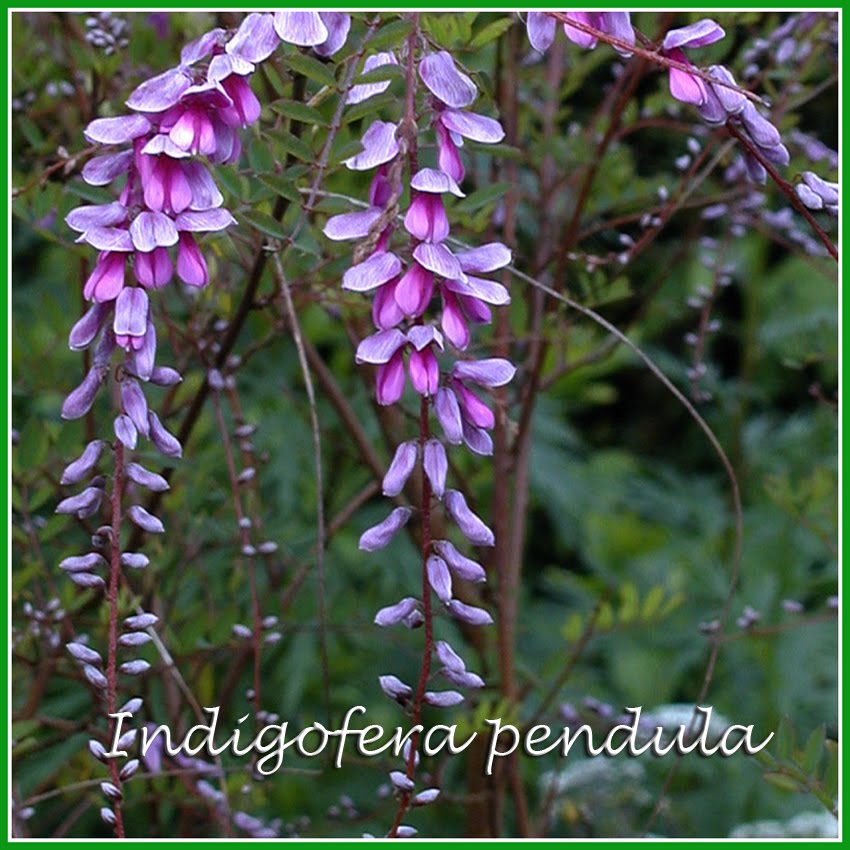
Indigofera pendula comes out later and is a more fastigiate grower. It has pinky-lilac flowers that hang from the branches for many weeks.

Indigofera subverticillata beats the lot.
It starts in June and seems to go on all summer and into the autumn. The flowers are pink but fuller and with a hint of peach. Mine is 8' high and was undeterred  by last winter - but I do grow it against a wall.

Wednesday, May 19, 2010

COW PARSLEY TIME.

Three of my favourites are at their best now.

Smyrnium perfoliatum is biennial but it takes a little time to get a colony established.
If you can get hold of a pot of seedlings plant them as they are and leave them alone.
It is the greeny-yellow colour of a Euphorbia and stands at about 2’ high.


Chaerophyllum hirsutum ‘Roseum’ is far better behaved. It is perennial and has soft lilac mauve flowers. If you remove the spent flowers you are left with the delightful ferny foliage scented of apples.


Zizia aurea is also perennial, but shorter with neat yellow flowers and a tidy habit. It does not have the same presence as the other two but is an easy and reliable plant.

Thursday, April 01, 2010

MARCH 2010

Despite the slow start three plants have given me great pleasure over the last few days.

Cardamine glanduligera comes into flower almost as soon as it emerges from the soil (usually in late February). It creeps fairly rapidly - but never becomes a pest as it disappears below ground in mid spring. It is yet another superb plant from Elizabeth Strangman of Washfield Nurseries.


The foliage of Veratrum dolichopetalum seems to appear before the rest of the family and is at its best right now.

The widow Iris - Hermodactylus tuberosum -is perfectly happy to naturalize in long grass with Narcissus and Scillas.

Thursday, March 25, 2010

WINTER LOSSES?

O.K so this winter has been cold.

However, the temperatures here have not dropped nearly as low as they did in the 2000 - 1 winter.
It has just been consistently cool for a long time.

Obviously some plants have died, and some just look battered and will probably recover.

From past experience Pittosporums have an unpleasant habit of looking sick, rallying and then succumbing ostentatiously long after the cold weather had been forgotten.

By July the winter should be just a memory - and not a large corpse.

If in doubt chuck any ailing Pittosporum on the bonfire right now.

Some young plants have a better chance of survival (like Cistus) some plants develop immunity to cold as they age

Is it all bad?

I suspect not.

Losses mean opportunities to try new plants, to revamp areas that were becoming tired and, more importantly, to decrease the slow increment of evergreens.

W are all prone to buy them and a succession of mild winter means they will prosper and subtly upset the balance between evergreen and deciduous. Too many evergreens in Britain gives an unnaturally 'heavy' look at odds with nature.


.

.

Sunday, November 29, 2009

STARS OF 2009

There are few thrills at this time of the year time of the year, Sarcoccoca wallichii and the lovely Narcissus Cedric Morris being among the exceptions. Although the summer of 2009 seemed an endless roll of wet days and low temperatures there were some plants that performed spectacularly, provided you could brave the global warming and get out to admire them.


ROSCOEA PURPUREA 'RED GURKHA' is the latest 'must have' in the family with large brick red flowers. It too likes part shade and never wants to dry out during it's growing season.


DEINANTHE CAERULEA is an easily grown chinese woodlander that likes a cool moist spot, and hates to be burnt by hot sun.


ORYZOPSIS MILACEA is a graceful, airy grass that begins to flower in June and goes on looking good right through until February. It probably prefers a hot summer but did look superb dripping the incessant moisture of last summer.

Thursday, August 27, 2009

CLIMBING ACONITUMS


The climbing aconites have loved this years wet summer and are looking their best now.


Aconitum austroyunnanense appears late but has shot up 12' into a variegated philadelphus and is covered in bright blue flowers.


Aconitum pseudo laeve is more of a loller than a climber, it has reached about 3' and leans against adjoining shrubs.


The pick of the bunch for me is Aconitum bulbilliferum. I only bought it this year, but it has grown to at least 8' and is covered in hooded claret coloured flowers.


All my plants came from the fantastic Crug Farm nursery and all of them seem happier growing in cool moist shade.


They give a late summer lift to any shrub that is looking a bit dull at this end of the season.

Thursday, August 13, 2009

CLIMBERS LOOKING GOOD IN AUGUST.


It is often said that August is a 'difficult month' and so it is cheering to have some climbers that peak now.

Itea illicifolia is an evergreen lolling shrub that grows happily against a north wall, albeit a light one. The splendid catkins seem longer than ever this year after three wet summers. If you have the energy try to visit them in the late evening to enjoy the fantastic smell.

Codonopsis grey-wilsonii is a delicate herbaceous climber and probably the most 'weedable out' plant you could grow. The fine thin shoots appear quite late in the spring and only need a gentle nudge towards the host plant. Plant it in shade and make sure it doesn't dry out.
When the flowers appear they are quite out of proportion to the stems and deserves the closest inspection.
Campsis 'Mme Galen' is no shrinking violet but an exotic 'in your face' orange.
It likes as much sun as it can get but seems oblivious to winter cold, and will flower throughout the last weeks of the summer .
.